











MSI Is A Global Association Of Over 250 Independent Legal And Accounting Firms In More Than 100 Countries. MSI Has A Successful Track Record Of More Than 25 Years And The Firm Has Recently Been Selected To Represent Mumbai, India.
Please Click Here To See MSI’s Info Graphic Which Highlights Key Facts Of The About. With The Membership At MSI, The Firm Has Now Access To 253 Legal And Accounting Firms Worldwide For Its Clients Who Desire To Do Cross Border Transactions Across The World.
Common Data Privacy Compliance Mistakes Businesses Should Avoid
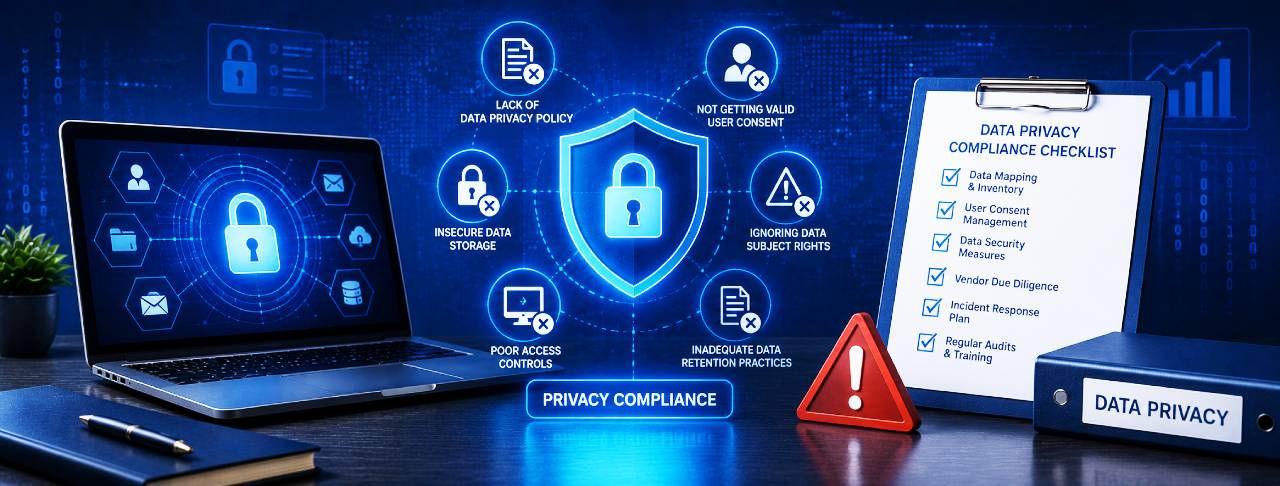
Data privacy compliance is becoming an important business responsibility in India. As organisations collect more customer, employee and user information, even a small process failure can create legal, operational and reputational consequences. The most common privacy compliance mistakes do not always arise from deliberate misconduct. They often result from outdated policies, poor data visibility, weak vendor controls or a failure to connect legal requirements with everyday business processes. For Indian businesses, the Digital Personal Data Protection Act, 2023 and the Digital Personal Data Protection Rules, 2025 provide the principal framework for digital personal data protection. The Rules were notified by the Ministry of Electronics and Information Technology in November 2025, with different provisions coming into force at different stages. Understanding common mistakes early can help businesses build practical privacy controls before compliance gaps become expensive problems.
What Does Privacy Compliance Mean for an Indian Business?
Privacy compliance involves more than publishing a privacy policy. A business needs to understand what personal data it collects, why it processes the data, who receives it, where it is stored, how it is secured and when it should be erased. Under the DPDP Act, organisations deciding the purpose and means of processing personal data are generally treated as Data Fiduciaries. Organisations processing data on their behalf may act as Data Processors. This distinction matters because responsibilities can extend across internal teams and external technology providers. For example, an online retailer may collect customer information through its website, transfer it to a payment provider, store account information with a cloud provider and use a marketing platform for communications. Each connection creates a data flow requiring appropriate oversight.
Mistake 1: Treating a Privacy Policy as Complete Compliance
One of the most common privacy compliance mistakes is assuming a well drafted privacy policy solves the compliance problem. It does not. A privacy notice describes processing. It does not automatically make the underlying processing lawful or secure. A company may state that personal information is deleted when no longer required. Yet its systems may retain old customer records indefinitely. A policy may promise appropriate security while employees continue using shared accounts or unrestricted spreadsheets. The real test is whether business practices match what the organisation communicates. Businesses should therefore review privacy documents alongside their actual technology systems, contracts and internal procedures. Current compliance commentary similarly identifies the gap between written policies and operational controls as a recurring weakness.
Mistake 2: Using a Generic Privacy Policy
A copied privacy policy may appear convenient, especially for a startup. It can also create significant problems. A generic document may refer to information the business does not collect while failing to disclose information it actually processes. It may describe rights or processing methods which do not match the organisation's systems. The better approach is to map actual data practices first. The privacy notice should then be prepared around the business model, technology environment, processing purposes and applicable legal requirements. A privacy notice should also be reviewed whenever the business introduces a major new product, tracking technology, vendor or processing purpose.
Mistake 3: Not Knowing Where Personal Data Is Stored
A business cannot properly protect information it cannot locate. Personal data often exists in more places than management realises. Customer relationship systems, cloud storage, employee devices, email accounts, spreadsheets, marketing platforms, support tools, application logs and backups may all contain personal information. Vendor systems can create another layer of complexity. A business may know its primary customer database but have limited visibility over information copied into third party systems. This can make it difficult to respond properly to correction, erasure or access related requests. A data inventory should therefore identify major data stores, purposes, owners, users, vendors and retention periods.
Mistake 4: Assuming All Data Is Automatically Covered by Consent
Consent is important, but businesses should not treat it as a universal answer. The DPDP Act provides for processing based on consent as well as specified legitimate uses. Where consent is relied upon, it needs to meet the statutory requirements. The business should understand precisely why consent is being obtained and what processing it relates to. A common operational problem occurs when one broad consent statement is used for several unrelated purposes. Businesses should instead examine whether each processing activity has an appropriate legal basis and whether the notice and consent mechanism accurately reflect the intended processing.
Mistake 5: Making Consent Difficult to Withdraw
Obtaining consent is only one part of consent management. Businesses also need a practical mechanism for withdrawal where consent is the basis for processing. If a user can provide consent in one simple step but must navigate several complicated screens to withdraw it, the process may create compliance and customer experience concerns. The DPDP Rules establish requirements concerning notices and mechanisms for exercising rights and withdrawing consent. Businesses should therefore test their consent journeys from a user's perspective.
Mistake 6: Ignoring Employee and Recruitment Data
Privacy programmes often focus heavily on customers. Employee information can receive less attention. Recruitment forms, CVs, identity documents, payroll information, attendance records, performance records and workplace communications can all involve personal data. HR teams should understand how information is collected, used, stored and shared. The same principle applies to former employees and unsuccessful candidates where relevant records remain in organisational systems. A privacy programme should therefore cover workforce data rather than focusing only on customer facing activities.
Mistake 7: Underestimating Vendor and Third Party Risk
A business remains exposed when personal data is transferred to external technology providers. Cloud platforms, CRM systems, payment providers, payroll vendors, analytics services and customer support platforms can all process personal data. Yet businesses sometimes select vendors based almost entirely on price and functionality. Privacy and security should form part of vendor assessment. Contracts should clearly address the permitted processing, confidentiality, security expectations, incident reporting, cooperation and handling of information when the relationship ends. Businesses should also maintain an up to date record of major processors and the information shared with them.
Mistake 8: Keeping Personal Data Indefinitely
“Keep it just in case” is a poor data governance strategy. Retaining unnecessary personal information increases the volume of information exposed if an incident occurs. It can also make rights requests more difficult to fulfil. Businesses should define retention periods based on the purpose of processing, legal requirements and legitimate business needs. The DPDP framework includes obligations relating to erasure and specific retention requirements under the Rules. Deletion should also extend beyond the main database where appropriate. Businesses should consider archives, shared drives, application environments and other systems containing copies of personal information.
Mistake 9: Ignoring Data Security
Privacy and security are closely connected, but they are not identical. A business may have strong cybersecurity controls yet still process information for unclear purposes or retain it longer than required. At the same time, poor security can directly increase privacy risk. Section 8 of the DPDP Act requires Data Fiduciaries to take reasonable security safeguards to prevent personal data breaches. Businesses should consider access controls, authentication, encryption where appropriate, monitoring, backups, vulnerability management and employee security practices. Security controls should be proportionate to the organisation's data and risk profile.
Mistake 10: Having No Data Breach Response Plan
Many businesses think about breach response only after an incident occurs. By then, valuable time may already be lost. A business should know how employees report suspected incidents, who investigates them, who assesses affected systems and who manages regulatory and individual communications. The DPDP Rules establish breach related obligations, including requirements concerning intimation to the Data Protection Board and affected Data Principals. An incident response plan should therefore be tested rather than merely documented. A short tabletop exercise can reveal whether legal, technology, communications and management teams understand their respective responsibilities.
Mistake 11: Forgetting Children's Personal Data
Children's data requires additional attention under the DPDP framework. The Act defines a child as an individual who has not completed eighteen years of age. It establishes additional requirements concerning verifiable parental consent and restricts certain forms of processing involving children. Businesses operating education platforms, gaming services, children's applications or other products likely to be used by minors should assess these requirements during product design. Age assurance and parental consent should not be added as an afterthought.
Mistake 12: Assuming GDPR Compliance Automatically Means DPDP Compliance
Some Indian businesses have already implemented GDPR programmes because they serve European customers. Those controls can provide a useful foundation. They do not automatically establish compliance with Indian law. The DPDP Act uses its own terminology, statutory framework and obligations. The Indian implementation timeline also follows a specific structure under the Act and Rules. Businesses should map existing privacy controls against the actual Indian requirements rather than simply declaring themselves DPDP compliant because they have a GDPR policy.
Mistake 13: Failing to Update Privacy Documents After Business Changes
Privacy practices evolve quickly. A company may introduce a new analytics tool, launch an application, start collecting location information, integrate an AI service or appoint a new marketing vendor. If the privacy notice remains unchanged, it may no longer accurately describe processing. A privacy review should therefore form part of the business change process. Product launches, acquisitions, new vendors, major technology changes and new markets should trigger a privacy assessment where relevant.
Mistake 14: Providing Privacy Training Only Once
Employees are often the first people handling personal information. Yet many organisations provide privacy training only during onboarding. Employees may later move between departments or begin using new systems. Their responsibilities can change significantly. Training should therefore be practical and role specific. Marketing teams need guidance on customer communications and data use. HR teams need guidance on employee information. Technology teams need security and access control awareness. Customer support teams need to recognise privacy requests.
Mistake 15: Treating Privacy Compliance as a One Time Project
Perhaps the biggest mistake is considering privacy compliance finished once the first audit is completed. Privacy is an ongoing business process. Technology changes. Vendors change. Laws evolve. Products expand. Data volumes increase. The DPDP Rules, 2025 themselves establish a phased implementation structure, with different provisions taking effect at different times. Businesses should therefore maintain a compliance calendar and review their controls periodically.
How Businesses Can Prevent Privacy Compliance Mistakes
The best way to reduce privacy errors is to connect legal requirements with operational controls. The process can begin with a data mapping exercise. The business should then identify its processing purposes, review its privacy notices, assess consent mechanisms, map vendors and establish retention rules. Next, the organisation should review security controls and create an incident response process. Responsibilities should be assigned internally. Privacy should not sit entirely with one person who has no control over technology, procurement or product decisions. For organisations considering privacy compliance lawyers, the most useful legal review is usually one connected to actual business processes. Legal advice should help translate statutory requirements into practical controls rather than simply produce another policy document.
A Practical Privacy Compliance Review
A useful internal review should ask several straightforward questions.
- Can the business identify all major categories of personal data it processes?
- Can it explain why each category is collected?
- Does its privacy notice accurately reflect those activities?
- Can it demonstrate consent where consent is relied upon?
- Can users exercise applicable rights through a practical process?
- Does the business know which vendors receive personal data?
- Are access permissions reviewed regularly?
- Are retention and deletion rules implemented in practice?
- Can the organisation respond quickly to a suspected breach?
- Can it demonstrate compliance through appropriate records?
If the answer to several questions is no, the organisation may have a meaningful privacy gap even if it has a polished privacy policy.
Why Privacy Mistakes Can Become Business Risks
Privacy failures can create more than regulatory exposure. They can delay enterprise contracts. Customers may hesitate to use a service. Investors may raise questions during due diligence. Vendors may require additional contractual protections. A serious incident can also consume management time and damage reputation. For growing organisations, weak privacy governance can become increasingly difficult to correct because data flows multiply as the business expands. Early investment in proper governance can therefore be more efficient than attempting to reconstruct privacy controls after a major incident. Businesses seeking support from corporate compliance lawyers should consider privacy as part of wider corporate governance rather than treating it as a standalone technology issue.
Conclusion
Most privacy failures are preventable. The biggest risk arises when businesses assume compliance exists because a privacy policy has been published or a consent box has been added to a website. Effective privacy governance requires much more. Businesses need visibility over their data, clear processing purposes, appropriate consent mechanisms, reliable vendor controls, sensible retention practices and reasonable security safeguards. They also need processes capable of responding to individual rights requests and personal data breaches. For Indian businesses, the DPDP Act, 2023 and DPDP Rules, 2025 provide the central framework. The official legislation and Rules should be consulted when determining the current legal position because the framework has phased commencement and detailed requirements.
Frequently Asked Questions (FAQs)
Q1. What are the most common privacy compliance mistakes businesses make?
The most common mistakes include using generic privacy notices, failing to map personal data, relying on poorly designed consent mechanisms, overlooking vendor risk, retaining information indefinitely, ignoring employee data and failing to prepare for breaches.
Q2. Is having a privacy policy enough for compliance?
No. A privacy policy is only one part of a broader compliance framework. The organisation's actual practices, systems, contracts and security measures should align with its stated privacy commitments.
Q3. Does every business need consent before processing personal data?
Not necessarily. The DPDP Act recognises consent as well as specified legitimate uses. Businesses should identify the appropriate statutory basis for each processing activity.
Q4. How often should a business review its privacy compliance?
There is no universal review frequency suitable for every organisation. A review should occur periodically and whenever significant changes occur in products, technology, vendors, processing purposes or applicable law.
Q5. What should businesses do after discovering a data breach?
The business should activate its incident response process, assess the incident, contain the issue, preserve relevant evidence and determine applicable notification and reporting obligations under the DPDP framework and any other applicable law.
Q6. Are startups required to think about privacy compliance?
Yes. A startup's size does not automatically remove privacy considerations. Early privacy governance can also prevent expensive restructuring when the customer base, technology environment and data volume increase.
Q7. Does the DPDP Act apply to employee data?
Personal data processed in digital form can fall within the Act's framework, subject to the Act's scope and applicable provisions. Businesses should therefore assess employee and recruitment data rather than assuming privacy compliance concerns only customers.
Q8. Does children's data have additional protection?
Yes. The DPDP Act contains additional requirements for processing children's personal data, including verifiable parental consent and restrictions on specified forms of processing.
Q9. What is the biggest privacy compliance mistake?
There is no single mistake applicable to every business. However, treating compliance as paperwork rather than an operational system is a recurring problem. A policy cannot compensate for unknown data flows, weak security, unmanaged vendors or ineffective rights processes.
The information contained in this communication is intended solely for the use of the individual or entity to whom it is addressed and others authorized to receive it. This communication may contain confidential or legally privileged information. If you are not the intended recipient, any disclosure, copying, distribution or action taken relying on the contents is prohibited and may be unlawful. If you have received this communication in error, or if you or your employer does not consent to email messages of this kind, please notify the sender immediately by responding to this email and then delete it from your system. No liability is accepted for any harm that may be caused to your systems or data by this message.
OUR CLIENTS







MEDIA COVERAGES
AWARDS & RECOGNITION









AFFILIATIONS & ASSOCIATIONS

MEMBERS OF MSI GLOBAL ALLIANCE

MEMBERS OF ILF
International Law Firms (ILF) Is An International Association Of Independent Smaller And Mid-Sized Law Firms Serving Their Clients’ Needs In Cross Border Business Legal Issues. Our Association With ILF Enables Us To Effectively Assist Clients With Trans-National Legal Issues At Effective Prices.
LIFE AT MHCO















PRACTICE AREA
Private Limited Company Registration in India
Setting up a Company in India
Foreign Direct Investment (FDI) in India
Foreign Business Registration in India
Small Business Registration in India
GET IN TOUCH
Mumbai: Surya Mahal, 2nd Floor 5, Burjorji Bharcha Marg Fort, Mumbai-400 023 India
Contact No.: T: +91-22-40565252
E: contact@mhcolaw.com
Delhi: C-9, Lower Ground Floor Jangpura Extension, New Delhi-110 0014 India
Contact No.: T: +91-11-40196496
E: contact@mhcolaw.com
Contact No.: T: +91-22-40565252
E: contact@mhcolaw.com
Delhi: C-9, Lower Ground Floor Jangpura Extension, New Delhi-110 0014 India
Contact No.: T: +91-11-40196496
E: contact@mhcolaw.com
2025 - MANSUKHLAL HIRALAL & CO.
Need Help? Chat with us