










MSI Is A Global Association Of Over 250 Independent Legal And Accounting Firms In More Than 100 Countries. MSI Has A Successful Track Record Of More Than 25 Years And The Firm Has Recently Been Selected To Represent Mumbai, India.
Please Click Here To See MSI’s Info Graphic Which Highlights Key Facts Of The About. With The Membership At MSI, The Firm Has Now Access To 253 Legal And Accounting Firms Worldwide For Its Clients Who Desire To Do Cross Border Transactions Across The World.
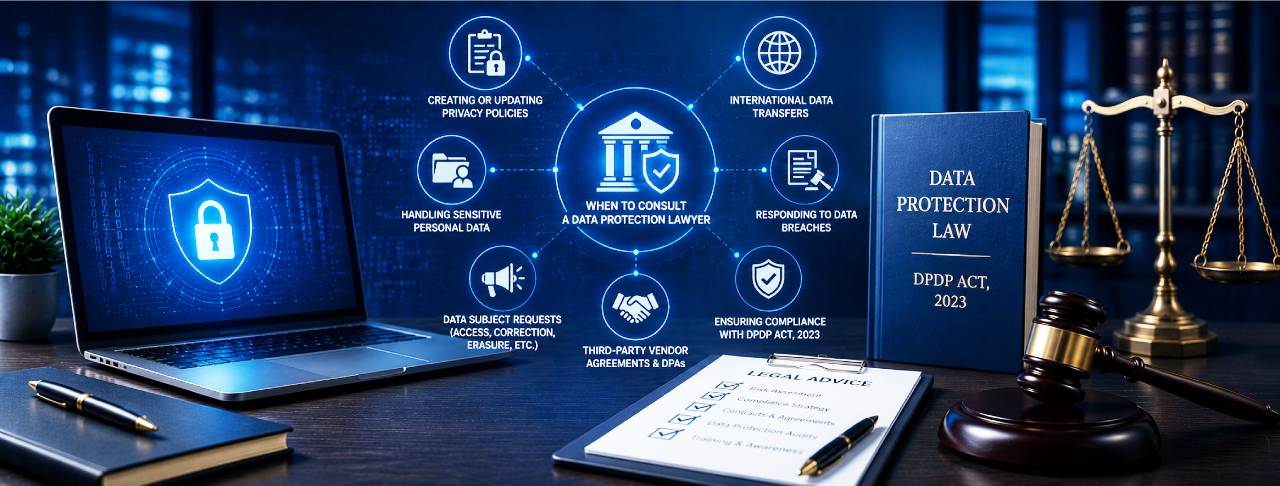
When Should a Business Consult a Data Protection Lawyer?
Businesses increasingly collect customer, employee, vendor and user information through websites, applications, cloud platforms and internal systems. As India's privacy framework develops, seeking privacy legal advice at the right stage can prevent avoidable compliance gaps and expensive remediation. The Digital Personal Data Protection Act, 2023, together with the Digital Personal Data Protection Rules, 2025, creates obligations around notice, consent, security safeguards, rights, children's data, breach response and governance. The Rules were notified in November 2025 and provide a phased implementation framework.
The important question for a business is not simply whether it needs a lawyer after receiving a regulatory notice. Legal advice can be considerably more valuable before a new product launches, a major data processing activity begins or a serious incident occurs.
What Does Privacy Legal Advice Actually Cover?
Privacy legal advice is broader than drafting a privacy policy. A business may need legal guidance on whether a proposed processing activity falls within the Digital Personal Data Protection Act, 2023, how notice should be presented, whether consent is appropriate, how rights should be handled and how contracts with Data Processors should be structured. The Act distinguishes between Data Fiduciaries, which determine the purpose and means of processing personal data, and Data Processors, which process personal data on behalf of a Data Fiduciary. The distinction affects contractual arrangements and accountability. Legal advice can also become relevant where privacy overlaps with employment law, consumer protection, cybersecurity, intellectual property, technology contracts, sector specific regulation or cross border business operations.
When Should a Business Consult a Data Protection Lawyer?
Before Launching a Data Driven Product
The ideal time to seek legal input is often before a product reaches customers. Consider a mobile application collecting names, contact details, location information and behavioural data. The legal team should understand why each category is being collected and how it will be used before the product architecture becomes difficult to change. Early legal review can identify unnecessary data collection, unclear purposes, unsuitable consent mechanisms and contractual gaps with technology providers. This approach is particularly useful for technology businesses, fintech platforms, healthcare providers, educational platforms, e commerce businesses and digital services.
When Collecting a New Category of Personal Data
Not every data collection activity carries the same risk. A business may initially collect basic contact information. Later, it may introduce location tracking, financial information, identity documents, biometric information or detailed behavioural profiles. Such changes should trigger a privacy assessment. The question is not simply whether the business can technically collect the information. It should also consider the purpose, necessity, transparency, security and retention implications. A lawyer can help assess the legal position before the new processing activity becomes embedded across multiple systems.
Before Introducing a New Consent Mechanism
Consent design is often treated as a technology issue. It is also a legal issue. The DPDP Act contains specific provisions concerning consent, while the 2025 Rules prescribe requirements concerning notices and consent mechanisms. Rule 3, for example, requires notices to be presented independently and in clear and plain language, with an itemised description of personal data and the specified purposes of processing. A lawyer can review whether the proposed consent journey reflects the statutory requirements. This is particularly important when consent is collected through mobile applications, websites, digital forms or integrated third party services.
When Children May Use the Service
Businesses serving children or operating platforms reasonably likely to be used by minors should obtain specialist advice before collecting their information. Section 9 of the DPDP Act deals specifically with processing personal data of children. The framework includes requirements concerning verifiable parental consent and restrictions on specified forms of processing involving children. Age assurance, parental consent, advertising practices and product design can all require careful consideration. For an education platform or children's application, privacy advice should ideally be obtained during product development rather than after launch.
Before Signing Important Vendor Contracts
Businesses often focus heavily on commercial terms when appointing cloud providers, CRM platforms, marketing technology providers, payroll companies or analytics vendors. Privacy provisions can receive less attention. This can create difficulties later when a business discovers its contract does not properly address security, confidentiality, data processing, incident reporting or cooperation with rights requests. A data protection lawyer can review relevant agreements and identify whether the contractual allocation of responsibilities reflects the actual data flow. This is particularly important where a vendor will have access to substantial volumes of personal data.
When Expanding Into New Markets
International expansion can create additional privacy questions. An Indian business serving customers abroad may become subject to foreign privacy legislation depending on its activities and the jurisdiction involved. At the same time, the DPDP Act contains provisions concerning processing of personal data outside India in certain circumstances, while the Rules provide additional detail within the wider framework. A business should therefore obtain legal advice before assuming its existing Indian privacy framework can simply be used in every foreign market.
During a Merger, Acquisition or Investment
Privacy issues can become significant during corporate transactions. An investor or acquirer may examine how the target company collects, stores, transfers and protects personal data. They may also review privacy complaints, vendor contracts, security incidents, policies and regulatory correspondence. Weak privacy governance can become a due diligence issue. A business preparing for fundraising or acquisition should consider a privacy review well before the transaction begins. Early identification of gaps gives management time to correct problems rather than explaining unresolved issues during negotiations.
After a Suspected Data Breach
A suspected breach is one of the clearest situations requiring prompt legal attention. The organisation should establish what happened, what information may have been affected, which systems are involved and what regulatory or contractual obligations may apply. The DPDP Rules, 2025 contain specific provisions concerning notification of personal data breaches. MeitY's explanatory note states that a Data Fiduciary must notify affected Data Principals promptly and inform the Data Protection Board without delay, followed by more detailed information within the prescribed timeframe. Legal advice can help coordinate the regulatory, contractual and communications aspects of the response.
When a Customer Exercises Privacy Rights
The DPDP Act provides Data Principals with rights including access to information, correction and erasure, grievance redressal and nomination, subject to the statutory framework. Businesses need an operational process for responding to such requests. A lawyer can help determine the scope of the request, applicable timelines, identity verification requirements, exemptions and the appropriate response. Repeated requests can also reveal weaknesses in the organisation's underlying data management systems. Privacy Legal Advice Is Important for Vendor Management Third party risk deserves particular attention. A business may have strong internal controls but still expose personal data through an external service provider. Cloud hosting, payroll processing, customer support, payment processing and marketing platforms can all create data flows outside the company's direct infrastructure. Legal review should therefore be connected to procurement. Before onboarding a major vendor, the business should understand what information will be shared, why it is required, how the vendor will process it and what contractual protections apply.
When Should a Startup Seek Privacy Advice?
Startups sometimes postpone legal review until they have substantial revenue or a large customer base. This can be a false economy. A young business can build privacy controls into its product architecture more easily than an established business can rebuild systems later. The right time for data protection legal advice may be before incorporation if the proposed business model depends heavily on personal data. It is especially relevant before launching a consumer application, handling sensitive information, processing children's data or entering international markets. The goal is not to create unnecessary paperwork. It is to prevent privacy obligations from becoming an expensive technical problem later.
What Should a Business Prepare Before Consulting a Lawyer?
A legal consultation becomes considerably more useful when the business can explain its actual data practices. The organisation should be able to describe its products, major categories of personal data, collection points, processing purposes, principal vendors, storage arrangements and existing privacy documents. It is also helpful to identify recent or planned changes, such as a new application, new analytics provider, acquisition, international expansion or proposed marketing programme. A lawyer can then assess the legal position against the actual business model rather than reviewing isolated documents.
Privacy Advice Should Involve More Than the Legal Team
Privacy compliance is not solely a legal function. Technology teams control infrastructure. Product teams design user journeys. Marketing teams determine how customer information is used. HR teams handle employee information. Procurement teams appoint vendors. Legal advice works best when these functions participate in the process. A business may therefore benefit from involving corporate legal advisors when privacy issues intersect with contracts, employment arrangements, corporate transactions or wider governance matters. The objective should be clear allocation of responsibility rather than placing every privacy task on the legal department.
How Often Should a Business Review Its Privacy Position?
There is no universal review interval suitable for every organisation. A business handling limited personal data may have a different risk profile from a large digital platform. However, certain events should trigger a review. These include a major product launch, new category of personal data, significant vendor appointment, international expansion, corporate transaction, security incident or material change in applicable law. The DPDP Rules, 2025 also use a phased commencement structure. Rules 1, 2 and 17 to 21 came into force upon publication, Rule 4 comes into force one year later, while Rules 3, 5 to 16, 22 and 23 come into force eighteen months after publication. Businesses should therefore monitor the implementation timetable rather than treating the November 2025 notification as the end of the compliance exercise.
What Happens If a Business Waits Too Long?
Late legal intervention can make remediation considerably harder. A company may discover its privacy notice does not match its systems. Its contracts may fail to address data processing. Consent records may be incomplete. Old information may exist across several platforms. Employees may have no defined procedure for handling rights requests. Correcting each issue individually can become costly. Early legal review allows businesses to identify structural problems before they spread across products, contracts and internal processes.
Conclusion
A data protection lawyer is most useful before a privacy problem becomes a dispute. Businesses should consider seeking legal advice when they design data intensive products, introduce new processing activities, collect children's data, appoint major technology vendors, expand internationally, prepare for investment, receive privacy requests or experience a data breach. India's privacy framework is also moving through a phased implementation process following notification of the DPDP Rules, 2025. Businesses should therefore track the statutory requirements and implementation dates rather than relying on outdated compliance assumptions.
Frequently Asked Questions (FAQs)
Q1. Does every business need a data protection lawyer?
Not every business requires permanent external legal counsel. However, businesses processing significant volumes of personal data, handling children's information, using complex technology systems, operating across borders or facing a privacy incident may benefit from specialist legal advice.
Q2. Is a privacy policy legally sufficient?
No. A privacy policy is only one component of privacy governance. The organisation's actual processing activities, security safeguards, contracts, consent mechanisms and rights handling procedures should also be assessed.
Q3. Should a startup consult a data protection lawyer before launching?
For data intensive startups, early advice can be highly valuable. Reviewing privacy requirements before launch can prevent expensive changes to product architecture, consent journeys and vendor contracts.
Q4. When should a company seek legal advice after a data breach?
As soon as a material breach or suspected breach is identified, businesses should consider obtaining appropriate legal advice. Prompt assessment can help determine applicable notification, contractual and regulatory obligations.
Q5. Can a corporate lawyer handle privacy matters?
A corporate lawyer may be able to address privacy issues connected with contracts, investments, acquisitions and general governance. More complex matters may require a lawyer with specific data protection and technology law expertise.
Q6. What is the role of a data protection lawyer?
A data protection lawyer can advise on privacy obligations, data processing structures, notices, consent, rights management, vendor contracts, breach response, regulatory issues and privacy risks arising from business activities.
Q7. Does privacy compliance need to be reviewed every year?
A periodic review is sensible, but businesses should also conduct reviews after material changes. New products, vendors, data categories, markets, security incidents and legal developments can all change the compliance position.
The information contained in this communication is intended solely for the use of the individual or entity to whom it is addressed and others authorized to receive it. This communication may contain confidential or legally privileged information. If you are not the intended recipient, any disclosure, copying, distribution or action taken relying on the contents is prohibited and may be unlawful. If you have received this communication in error, or if you or your employer does not consent to email messages of this kind, please notify the sender immediately by responding to this email and then delete it from your system. No liability is accepted for any harm that may be caused to your systems or data by this message.
OUR CLIENTS







MEDIA COVERAGES
AWARDS & RECOGNITION









AFFILIATIONS & ASSOCIATIONS

MEMBERS OF MSI GLOBAL ALLIANCE

MEMBERS OF ILF
International Law Firms (ILF) Is An International Association Of Independent Smaller And Mid-Sized Law Firms Serving Their Clients’ Needs In Cross Border Business Legal Issues. Our Association With ILF Enables Us To Effectively Assist Clients With Trans-National Legal Issues At Effective Prices.
LIFE AT MHCO















PRACTICE AREA
Private Limited Company Registration in India
Setting up a Company in India
Foreign Direct Investment (FDI) in India
Foreign Business Registration in India
Small Business Registration in India
GET IN TOUCH
Mumbai: Surya Mahal, 2nd Floor 5, Burjorji Bharcha Marg Fort, Mumbai-400 023 India
Contact No.: T: +91-22-40565252
E: contact@mhcolaw.com
Delhi: C-9, Lower Ground Floor Jangpura Extension, New Delhi-110 0014 India
Contact No.: T: +91-11-40196496
E: contact@mhcolaw.com
Contact No.: T: +91-22-40565252
E: contact@mhcolaw.com
Delhi: C-9, Lower Ground Floor Jangpura Extension, New Delhi-110 0014 India
Contact No.: T: +91-11-40196496
E: contact@mhcolaw.com
2025 - MANSUKHLAL HIRALAL & CO.
Need Help? Chat with us